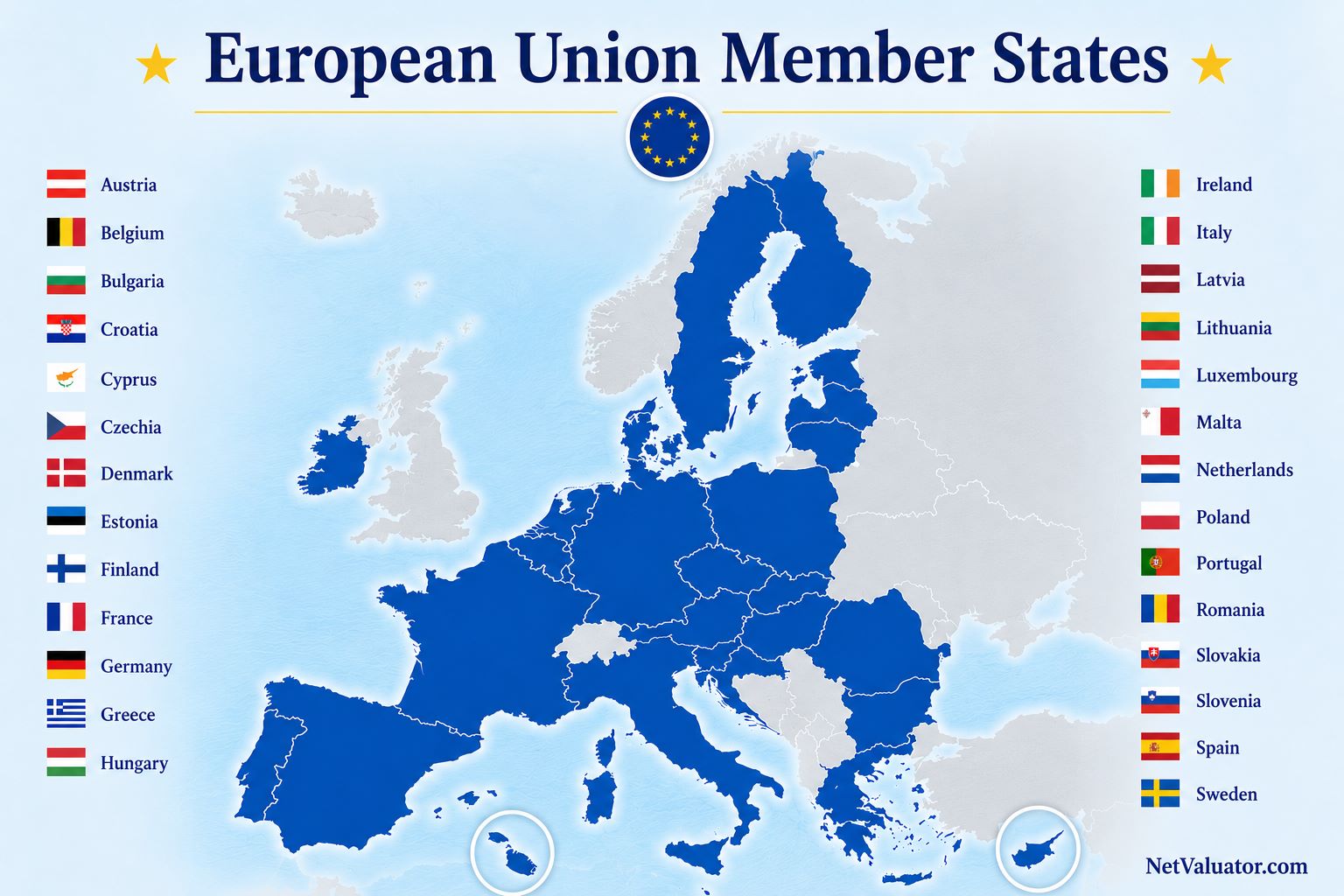
European Union Member States and the History of EU Enlargement

🌍 How the European Union Expanded Through Decades of Political and Economic Cooperation
The European Union is one of the most influential political and economic alliances in modern history. What began as a small cooperation project between several European nations gradually transformed into a powerful community uniting countries with shared goals and democratic values. The story of EU enlargement reflects decades of negotiation, compromise, and the desire for lasting peace across Europe.
📜 The Origins of European Integration After World War II
After the devastation caused by World War II, many European leaders believed that closer cooperation could prevent future conflicts on the continent. France, West Germany, Italy, Belgium, the Netherlands, and Luxembourg decided to connect important industries such as coal and steel to reduce political tensions. This cooperation later became the foundation for broader economic and political integration across Europe.
The Treaty of Rome, signed in 1957, officially created the European Economic Community and introduced the idea of a common market between participating nations. The agreement encouraged free trade, easier movement of goods, and stronger economic growth among the founding countries. Over time, these early successes convinced additional European states that joining the community could bring stability and prosperity.
🏛️ The First Expansions and Growing European Cooperation
The first enlargement of the European community took place in 1973 when Denmark, Ireland, and the United Kingdom became members. Their accession marked an important turning point because it demonstrated that the organization was attractive beyond the original founding states. European cooperation started to gain global importance as economic ties between member nations became stronger and more organized.
In the following decades, southern European countries such as Greece, Spain, and Portugal joined the community after periods of political transformation. These nations had recently moved away from authoritarian governments and viewed European integration as a guarantee of democratic development. Their entry also showed that the organization supported both economic modernization and democratic stability across the continent.
💶 The Creation of the European Union and New Political Goals
The Maastricht Treaty, signed in 1992, officially established the European Union and introduced deeper political cooperation between member states. Beyond trade and economics, the EU began focusing on foreign policy, security, environmental protection, and common citizenship rights. This moment represented a major evolution from a simple economic partnership into a broader political alliance.
During the 1990s, several neutral and economically developed countries, including Austria, Finland, and Sweden, joined the European Union. Their accession strengthened the EU’s position in Northern Europe and expanded cooperation into new regions. At the same time, discussions about introducing a common currency and increasing institutional cooperation became central topics inside the growing organization.
🗺️ Eastern Europe and the Historic Enlargement of 2004
The largest enlargement in European Union history took place in 2004 when ten countries joined simultaneously, many of them from Central and Eastern Europe. Nations that had once belonged to the Soviet sphere of influence saw EU membership as an opportunity for economic growth and stronger democratic institutions. The accession process required years of reforms related to law, administration, and market regulations.
This historic expansion symbolized the reunification of Europe after decades of political division during the Cold War. Countries such as Poland, the Czech Republic, Hungary, and the Baltic states strengthened the EU’s cultural and economic diversity. The enlargement also increased the importance of cooperation between eastern and western parts of Europe within a shared political framework.
🔄 Modern Challenges and the Future of EU Enlargement
In recent years, the European Union has faced numerous challenges connected to migration, economic crises, geopolitical tensions, and debates about sovereignty. Despite these difficulties, several Balkan countries and other European nations continue negotiations aimed at future membership. The enlargement process remains demanding because candidate countries must meet strict legal, political, and economic standards.
The departure of the United Kingdom from the European Union in 2020 created a unique moment in the organization’s history. Brexit demonstrated that membership in the EU is not irreversible and sparked debates about the future direction of European integration. Nevertheless, many countries still consider EU membership an important strategic goal connected to stability, investment, and international cooperation.
🇪🇺 European Union Member States by Population and Historical EU Enlargement
This table presents all current European Union member states ordered from the largest to the smallest population size. It also highlights the historical context of each country’s accession and its importance within the broader process of European integration.
| LP | Country / population | Capital / population | Comment on EU accession |
|---|---|---|---|
| 1 | 🇩🇪 Germany 83.6 million |
Berlin 3.8 million |
Germany was a founding member, and its reconciliation with France became a cornerstone of the European project. |
| 2 | 🇫🇷 France 68.6 million |
Paris 2.0 million |
France was a founding member and one of the main political architects of European integration after World War II. |
| 3 | 🇮🇹 Italy 58.9 million |
Rome 2.7 million |
Italy was a founding member and hosted the Treaty of Rome, one of the key documents of European integration. |
| 4 | 🇪🇸 Spain 49.0 million |
Madrid 3.5 million |
Spain joined in 1986, and accession confirmed its democratic transformation after the Franco era. |
| 5 | 🇵🇱 Poland 36.6 million |
Warsaw 1.9 million |
Poland joined in 2004, becoming the largest country of the historic Central and Eastern European enlargement. |
| 6 | 🇷🇴 Romania 19.0 million |
Bucharest 1.7 million |
Romania entered the EU in 2007, extending the Union’s reach further into Southeastern Europe. |
| 7 | 🇳🇱 Netherlands 18.0 million |
Amsterdam 0.9 million |
The Netherlands was a founding member and strongly supported the creation of a common European market. |
| 8 | 🇧🇪 Belgium 11.8 million |
Brussels 1.2 million |
Belgium was one of the founding members, helping shape the institutions that later became the modern European Union. |
| 9 | 🇨🇿 Czechia 10.9 million |
Prague 1.4 million |
Czechia joined in 2004, symbolizing the post-communist return of Central Europe to European integration. |
| 10 | 🇵🇹 Portugal 10.6 million |
Lisbon 0.5 million |
Portugal joined in 1986, linking EU accession with democratic consolidation after decades of authoritarian rule. |
| 11 | 🇸🇪 Sweden 10.6 million |
Stockholm 1.0 million |
Sweden entered in 1995, strengthening the EU’s Nordic profile and expanding cooperation in Northern Europe. |
| 12 | 🇬🇷 Greece 10.4 million |
Athens 0.6 million |
Greece joined in 1981, becoming the first southern enlargement after its transition back to democracy. |
| 13 | 🇭🇺 Hungary 9.6 million |
Budapest 1.7 million |
Hungary joined in 2004, reflecting the major eastward enlargement that followed the end of the Cold War. |
| 14 | 🇦🇹 Austria 9.2 million |
Vienna 2.0 million |
Austria joined the European Union in 1995, strengthening the EU’s Central European dimension after the Cold War. |
| 15 | 🇧🇬 Bulgaria 6.4 million |
Sofia 1.2 million |
Bulgaria entered the EU in 2007, marking another important stage in the Union’s enlargement toward Southeastern Europe. |
| 16 | 🇩🇰 Denmark 6.0 million |
Copenhagen 0.7 million |
Denmark entered in 1973, during the first enlargement that expanded the Community beyond its original founders. |
| 17 | 🇫🇮 Finland 5.6 million |
Helsinki 0.7 million |
Finland joined in 1995, linking the EU more closely with Northern Europe and the Baltic Sea region. |
| 18 | 🇸🇰 Slovakia 5.4 million |
Bratislava 0.5 million |
Slovakia joined in 2004, shortly after major political and economic reforms aligned it with EU standards. |
| 19 | 🇮🇪 Ireland 5.4 million |
Dublin 0.6 million |
Ireland entered in 1973, and EU membership later became closely linked with its economic modernization. |
| 20 | 🇭🇷 Croatia 3.9 million |
Zagreb 0.8 million |
Croatia became the newest EU member in 2013, completing a long accession process after the Yugoslav conflicts. |
| 21 | 🇱🇹 Lithuania 2.9 million |
Vilnius 0.6 million |
Lithuania entered the EU in 2004, completing the Baltic states’ integration into the European Union. |
| 22 | 🇸🇮 Slovenia 2.1 million |
Ljubljana 0.3 million |
Slovenia joined in 2004 as the first former Yugoslav republic to become part of the European Union. |
| 23 | 🇱🇻 Latvia 1.9 million |
Riga 0.6 million |
Latvia joined in 2004, reinforcing the EU’s Baltic enlargement and its post-Soviet democratic transformation. |
| 24 | 🇪🇪 Estonia 1.4 million |
Tallinn 0.5 million |
Estonia joined in 2004, bringing the Baltic region firmly into the European Union after decades of Soviet domination. |
| 25 | 🇨🇾 Cyprus 0.9 million |
Nicosia 0.2 million |
Cyprus joined in 2004, adding an important Mediterranean dimension to the historic enlargement of that year. |
| 26 | 🇱🇺 Luxembourg 0.7 million |
Luxembourg City 0.1 million |
Luxembourg was a founding member and has played an important role in hosting major European institutions. |
| 27 | 🇲🇹 Malta 0.6 million |
Valletta 0.006 million |
Malta joined in 2004, adding a small but strategically located Mediterranean state to the European Union. |
The history of the European Union is closely connected with the idea of peace, cooperation, and gradual integration between neighboring countries. Every enlargement wave reflected important political transformations occurring across the continent over many decades. Today, the European Union continues evolving while balancing its historical foundations with modern global challenges.
📚 Sources
1. Wikipedia – History of the European Union
2. European Union Official Website – europa.eu
3. Encyclopaedia Britannica – European Union History and Enlargement