
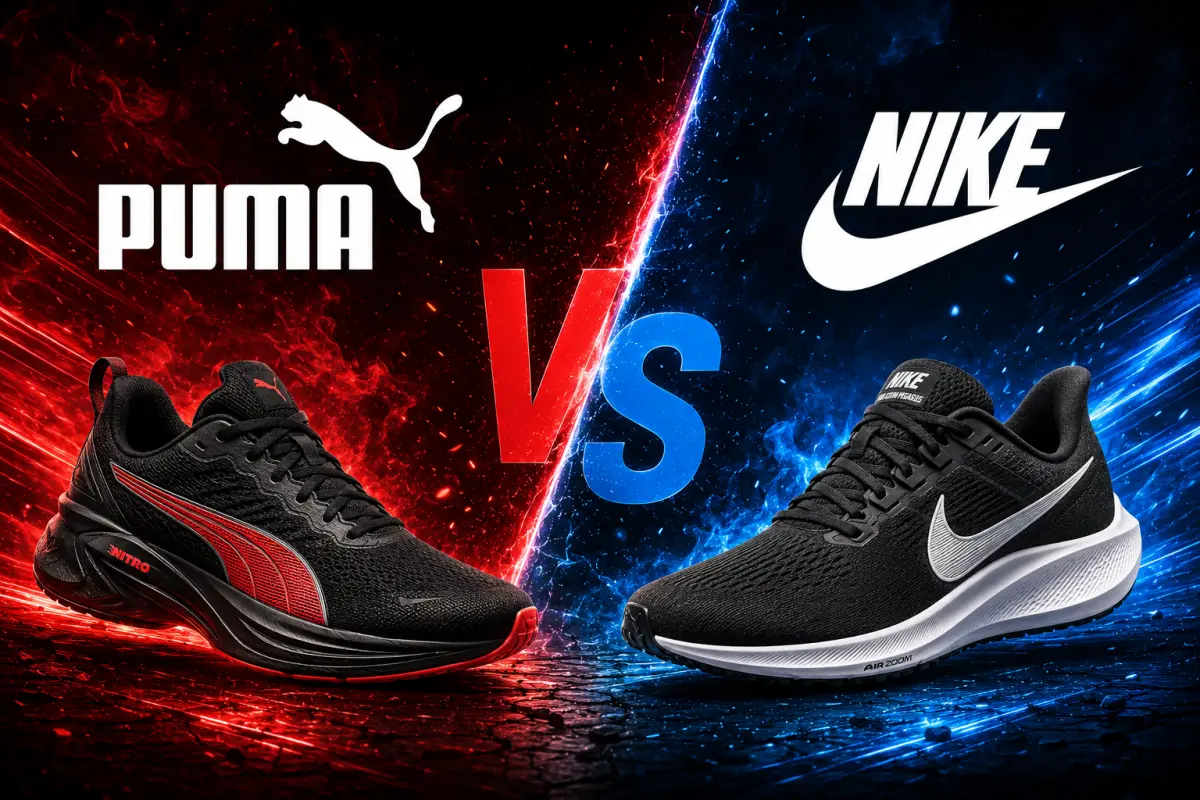
👟 Nike vs Puma: Which Sportswear Brand Is Better?
Nike and Puma are two of the most recognizable names in global sportswear, yet they occupy noticeably different positions in the market. Nike is the larger brand, with an enormous product catalogue, influential athlete partnerships and a particularly strong presence in basketball, running and sneaker culture. Puma competes with a more focused range, a strong football heritage and prices that are often more accessible.
Choosing between them is not simply a matter of picking the more famous logo. Comfort depends heavily on the individual model, while performance differences vary between running shoes, football boots, training apparel and everyday sneakers. This comparison examines their histories, product technologies, designs, sizing, sporting credentials, prices and sustainability efforts to determine where each brand performs best.
🇩🇪 Puma – Background and Key Characteristics
Puma was founded by Rudolf Dassler in Herzogenaurach, Germany, in 1948, following the separation of the Dassler brothers and the dissolution of their earlier footwear business. The company quickly established itself in football and athletics, supplying performance shoes to prominent competitors and national teams. Its famous Formstrip appeared on footwear in the late 1950s, while the jumping cat became one of the most recognizable logos in sportswear.
The company currently produces footwear, clothing and accessories for football, running, motorsport, basketball, training and casual use. Classic models such as the Puma Suede, Palermo and Speedcat connect the modern range with the brand’s long sporting history. Puma generally presents itself as the faster, more rebellious alternative to the industry’s two largest companies, Nike and Adidas.
🇺🇸 Nike – Background and Key Characteristics
Nike began as Blue Ribbon Sports in 1964, when Phil Knight and Bill Bowerman created a business that initially distributed Japanese running shoes in the United States. The company adopted the Nike name in 1971, inspired by the Greek goddess of victory, and introduced the Swoosh during the same period. Bowerman’s experiments with running footwear helped establish product innovation as a defining element of the brand.
Nike has since developed into the world’s largest athletic footwear and apparel company, with Nike, Jordan Brand and Converse under the broader NIKE, Inc. organization. Its catalogue covers running, basketball, football, tennis, skateboarding, golf, training and numerous lifestyle categories. Famous technologies and product families include Nike Air, Air Max, ZoomX, ReactX, Flyknit, Pegasus, Mercurial and the Air Jordan line.
1. 🏃 Performance Technology and Innovation
Puma’s modern performance range is considerably more advanced than its lower market share might suggest. Its running shoes use nitrogen-infused NITROFOAM for responsive cushioning, while selected racing and tempo models combine it with a carbon-fibre PWRPLATE designed to improve stability and energy transfer. Technologies such as PUMAGRIP also give many Puma running shoes excellent outsole traction, making models such as the Velocity NITRO and Deviate NITRO credible options for serious runners.
Nike offers a broader and more mature technology ecosystem, ranging from Air cushioning and ReactX foam to lightweight ZoomX foam, carbon Flyplates and Air Zoom units. These systems appear across daily trainers, racing shoes, basketball footwear and specialized competition models. Nike’s larger research budget and extensive access to elite-athlete feedback help it introduce new concepts at a scale that Puma cannot consistently match.
2. 🎨 Style, Lifestyle Shoes and Brand Identity
Puma’s style combines European sporting heritage with relatively clean, understated silhouettes. The Suede, Palermo, Easy Rider and Speedcat work particularly well with casual outfits because their branding is recognizable without dominating the entire design. Puma is therefore attractive to shoppers who want a heritage sneaker but would prefer something less ubiquitous than a Nike Air Force 1 or Dunk.
Nike has a much larger influence on modern sneaker culture and offers an exceptional variety of colors, collaborations and retro releases. Models such as the Air Force 1, Air Max 1, Air Max 90, Dunk and Air Jordan 1 have moved far beyond sport and become fashion staples. This cultural visibility gives Nike a clear advantage for collectors, although it can also make some models feel overly common or driven by hype.
3. 📏 Comfort, Fit and Sizing
Puma footwear is frequently described by buyers as relatively narrow through the midfoot, although the precise fit changes considerably between product lines. Some wearers choose half a size larger in heavily padded lifestyle shoes, whereas several modern running models fit true to size. Because sizing impressions on forums are inconsistent, measuring the foot and consulting the chart for the specific model is safer than applying one rule to every Puma shoe.
Nike also has a reputation for producing many shoes with a close or performance-oriented fit, especially football boots, racing shoes and certain classic sneakers. However, its vast catalogue includes wide versions of selected running models and enough different shapes to accommodate more foot types. Neither brand is universally more comfortable, but Nike usually makes it easier to find an alternative model without leaving the brand’s ecosystem.
4. ⚽ Sporting Heritage and Sponsorships
Puma has especially deep roots in football, where its boots have been worn by legendary players including Pelé, Johan Cruyff and Diego Maradona. The modern FUTURE, ULTRA and KING families continue that heritage, while the brand supplies prominent clubs, national teams and individual players. Puma is also highly visible in motorsport through its long association with racing teams and automotive-inspired clothing.
Nike has a wider sporting footprint and particularly powerful positions in basketball, running and global football. Its connection with Michael Jordan transformed both basketball footwear and the wider sneaker business, while athletes such as LeBron James, Cristiano Ronaldo and numerous Olympic champions have strengthened its worldwide visibility. Nike’s scale allows it to dominate more sporting categories simultaneously, although Puma can feel more distinctive in football and motorsport.
5. 💰 Prices, Discounts and Overall Value
Puma generally competes aggressively on value, with frequent promotions across its official store and third-party retailers. Its entry-level footwear and clothing are often cheaper than comparable Nike products, while discounted NITRO running shoes can offer particularly strong performance for the money. Shoppers who care more about practical quality than prestige may find Puma to be the better-value choice.
Nike covers a very wide price range, but many of its most desirable lifestyle and performance products command premium prices. Limited releases, Jordan models and flagship racing shoes can be expensive, and popular colorways are not always included in promotions. The higher price may be worthwhile for specialized technology, design selection or cultural status, but the Swoosh does not automatically guarantee better durability or comfort.
6. 🛍️ Product Range and Availability
Puma offers all the essential categories, including running shoes, football boots, gym clothing, casual sneakers and children’s products. Its selection is substantial but more curated, which can make shopping simpler for consumers who do not want to compare dozens of closely related models. Availability nevertheless varies by country, and some specialist Puma products can be difficult to find outside major online retailers.
Nike’s global distribution and much larger catalogue provide considerably more choice. Consumers can select from numerous cushioning levels, sport-specific designs, lifestyle collections, widths and premium editions, while the Nike and SNKRS apps support direct shopping and product launches. The disadvantage is that the range can become confusing, particularly when similarly priced shoes are intended for very different types of athletes.
7. ♻️ Sustainability and Materials
Puma reported that nine out of ten of its products made in 2024 contained recycled or certified materials, reaching one of its major sustainability targets ahead of the original deadline. Projects such as RE:FIBRE explore textile-to-textile recycling, while the company has established additional goals covering climate, water, biodiversity and human rights. These figures are encouraging, although a product containing a preferred material should not automatically be considered environmentally harmless.
Nike organizes much of its environmental work under the Move to Zero initiative, which describes its long-term journey toward zero carbon and zero waste. The company uses recycled polyester, reprocessed manufacturing waste and lower-impact materials in selected products, while technologies such as Flyknit can reduce upper-production waste compared with traditional construction. Nike’s enormous production volume means that improvements can have substantial effects, but it also makes transparency, durability and continued emissions reductions particularly important.
✅ Pros and Cons of Puma
Pros: Puma frequently provides better value, especially when its running shoes, football products and casual sneakers are discounted. The brand has genuine sporting credibility, competitive NITRO cushioning and a distinctive archive of understated lifestyle designs. Its smaller cultural footprint may also appeal to shoppers who want something recognizable without wearing the same models seen everywhere.
Cons: Puma cannot match Nike’s overall range, retail presence or number of specialized performance products. Fit can feel narrow in certain models, and limited local availability sometimes makes trying shoes before purchase difficult. Its lifestyle releases also tend to have less collector interest and weaker resale demand, which matters to sneaker enthusiasts even if it has little relevance to ordinary buyers.
✅ Pros and Cons of Nike
Pros: Nike offers exceptional variety, advanced performance technologies and influential designs across almost every major sporting category. Its running, basketball and football ranges include options for beginners, professionals and casual users, while its classic sneakers have enormous cultural importance. Broad distribution and a large model selection make it relatively easy to remain within the Nike ecosystem as personal needs change.
Cons: Nike products are often more expensive, and part of that premium reflects branding, athlete endorsements and market demand rather than a guaranteed improvement in quality. Limited releases and artificial scarcity can make popular sneakers frustrating to obtain at retail prices. The catalogue is also inconsistent enough that customers still need to research individual models instead of assuming every Nike shoe will fit or perform similarly.
📊 Puma vs Nike – Quick Comparison Table
Both Puma and Nike are internationally recognized sportswear brands, but they differ considerably in scale, pricing and sporting identity. The table below highlights the most important differences to help readers quickly decide which brand better matches their needs.
| Comparison Aspect | Puma | Nike |
|---|---|---|
| Founded | 1948 | 1971 as Nike; originally established as Blue Ribbon Sports in 1964 |
| Country of Origin | Germany | United States |
| Headquarters | Herzogenaurach, Germany | Beaverton, Oregon, USA |
| Famous Logo | Leaping Puma | Swoosh |
| Brand Slogan | “Forever Faster” | “Just Do It” |
| Strongest Market Position | Football, motorsport and affordable lifestyle wear | Running, basketball, training and sneaker culture |
| Most Popular Technologies | NITROFOAM, PWRPLATE and PUMAGRIP | Nike Air, Air Zoom, ZoomX, ReactX and Flyknit |
| Basketball Presence | Growing presence with competitive signature shoes | Industry leader through Nike Basketball and Jordan Brand |
| Football Heritage | Exceptional and historic | Strong global presence with a more modern heritage |
| Comfort for Everyday Wear | Very good, particularly in lightweight lifestyle sneakers | Very good, with a much wider selection of cushioning systems |
| Fashion Influence | Strong retro and European sportswear identity | Dominant influence on global sneaker culture |
| Premium Product Pricing | Generally more affordable | Usually higher, especially for flagship and limited-edition products |
| Running Shoe Innovation | Highly competitive and often excellent value | Market-leading, with a broader range of specialist models |
| Classic Sneaker Models | Suede, Palermo, Speedcat and Easy Rider | Air Force 1, Air Max, Dunk and Air Jordan |
| Sustainability Initiatives | Vision 2030, RE:FIBRE and Forever Better | Move to Zero and broader carbon- and waste-reduction programs |
| Notable Athlete Partnerships | Mondo Duplantis, LaMelo Ball, Breanna Stewart and Antoine Griezmann | LeBron James, Cristiano Ronaldo, Kylian Mbappé and Sha’Carri Richardson |
| Best For | Value-conscious buyers, football fans and motorsport enthusiasts | Performance-focused athletes, basketball players and sneaker collectors |
| Overall Brand Image | Speed, individuality and accessible sporting style | Innovation, elite performance and cultural influence |
| Overall Advantage | Better value and a more distinctive alternative to the largest brands | Greater variety, stronger technology ecosystem and wider global influence |
🏆 Final Verdict: Is Puma or Nike Better?
Nike is the stronger overall choice for buyers who want the widest selection, the most developed performance ecosystem and access to highly influential basketball, running and lifestyle products. It is particularly compelling for athletes who need specialized footwear or sneaker fans who value iconic designs and collaborations. However, Nike’s advantage in scale does not mean that every individual product is superior to its Puma equivalent.
Puma is often the smarter value choice for shoppers seeking capable running shoes, football equipment or stylish casual sneakers at a more approachable price. Its NITRO performance line proves that a smaller brand can compete seriously with Nike, while classics such as the Suede, Palermo and Speedcat offer a distinctive aesthetic. The final decision should be made model by model: choose Nike for maximum variety and cultural influence, or Puma for value, individuality and a particularly strong football and motorsport identity.
Both companies have enough history, technology and product diversity to serve athletes as well as everyday consumers. Whenever possible, try the exact shoe before buying, because foot shape and model construction matter much more than the logo printed on the side.


