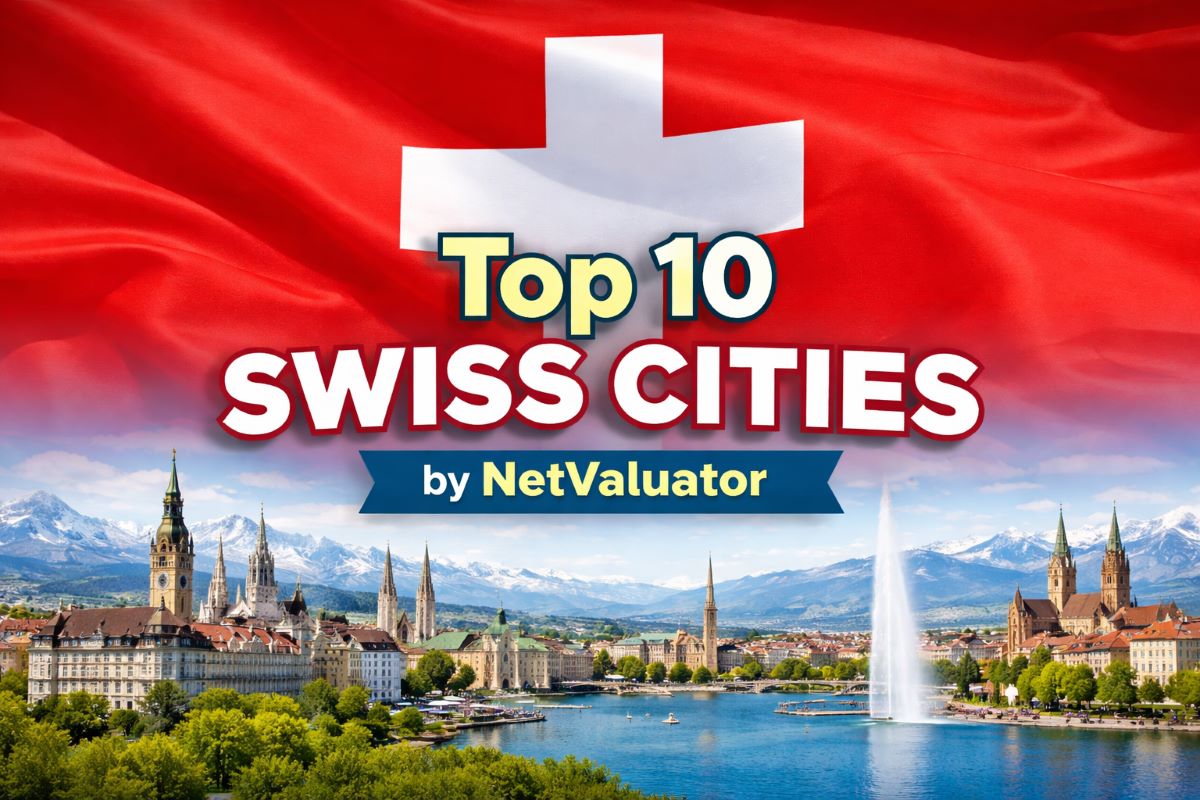
Top Ten Swiss Cities
Switzerland’s urban system is defined less by a single dominant megacity than by a network of prosperous regional centres spread across the country’s German-, French-, and Italian-speaking areas.
The figures and rankings below follow the 2011 municipal population data provided in the table, highlighting how Zurich leads clearly at the national level, while Geneva, Basel, Bern, and Lausanne anchor distinct metropolitan regions shaped by finance, diplomacy, industry, education, and cross-border links. They also reflect Switzerland’s multilingual character, with major cities divided between different linguistic and regional traditions rather than concentrated in one single urban core.
Top 10 Cities
1. Zurich — 366,445
Zurich is Switzerland’s largest city and its most powerful financial and economic centre, combining global banking, business services, and transport functions with a high quality of life and a strong cultural scene. Although its municipal population is modest by global standards, the wider Zurich agglomeration is by far the country’s largest urban region, reflecting the city’s role as the leading hub of German-speaking Switzerland. Zurich also stands out for its universities, lakeside setting, and reputation as one of Europe’s most influential mid-sized metropolitan economies.
2. Geneva — 177,500
Geneva is the main city of French-speaking Switzerland and one of the world’s most internationally connected urban centres due to its role in diplomacy and global governance. It hosts numerous international organisations, UN agencies, NGOs, and financial institutions, giving it a profile that far exceeds its municipal population size. Its metropolitan importance is reinforced by a cross-border urban region extending into France, making Geneva a uniquely international city in both economic and demographic terms.
3. Basel — 165,000
Basel is a major Rhine city at the meeting point of Switzerland, France, and Germany, giving it an unusually strong transnational character. The city is one of Switzerland’s key industrial and pharmaceutical centres, while also functioning as an important transport and logistics gateway through the Rhine corridor. Basel combines a historic urban core with major research institutions, museums, and cross-border commuting flows that make it one of the most outward-facing cities in the country.
4. Bern — 131,600
Bern is the federal capital of Switzerland and the political heart of the country, even though it is smaller than Zurich, Geneva, or Basel in population terms. Its historic centre, recognized for its medieval urban fabric, gives the city a distinct visual identity, while national government functions shape much of its administrative and professional economy. Bern also serves as a wider regional centre in the Swiss Plateau, balancing state institutions, education, and a relatively stable urban character.
5. Lausanne — 129,273
Lausanne is the leading urban centre of canton Vaud and one of the most important cities in French-speaking Switzerland. Built dramatically above Lake Geneva, it combines higher education, advanced services, culture, and international sports administration, including institutions linked to the Olympic movement. Lausanne’s influence extends well beyond its municipal limits, as its wider urban area forms part of the dense arc of settlement along the Lake Geneva shoreline.
6. Winterthur — 97,300
Winterthur is the second-largest city in canton Zurich and an important urban centre in its own right, despite lying within the broader orbit of Zurich. Historically associated with industry and engineering, it has evolved into a city with strong service functions, cultural institutions, and residential appeal. Its size and location make it one of the clearest examples of Switzerland’s polycentric urban pattern, where major secondary cities remain significant rather than being absorbed entirely by the biggest metropolis.
7. Lucerne — 77,491
Lucerne is one of Switzerland’s best-known historic cities, famous for its lake-and-mountain setting and its strong tourism appeal. At the same time, it is a major regional centre for central Switzerland, with administrative, educational, and transport importance extending beyond its picturesque old town. The city’s agglomeration is considerably larger than the municipality itself, underlining Lucerne’s role as a wider urban and service hub.
8. St. Gallen — 70,000
St. Gallen is the principal city of eastern Switzerland and an important regional centre close to the Austrian and German borders. The city has long combined commercial and industrial traditions with education, most notably through its well-known university and business profile. Although smaller than the leading Swiss metropolitan anchors, St. Gallen remains a significant urban node in a part of the country where cross-border relations and regional connectivity matter strongly.
9. Lugano — 64,200
Lugano is the largest city in Switzerland’s Italian-speaking region and the main urban centre of canton Ticino. Its economy mixes finance, services, and tourism, helped by its scenic lakeside location and close cultural and economic links with northern Italy. Lugano illustrates how Switzerland’s urban hierarchy is shaped not only by size, but also by linguistic and regional roles, since it clearly dominates the southern part of the country.
10. Biel/Bienne — 53,000
Biel/Bienne is one of Switzerland’s most distinctive bilingual cities, officially combining German and French linguistic traditions in a single urban municipality. The city is closely associated with precision industry and watchmaking, while also serving as a regional centre between the larger poles of Bern and western Switzerland. Its dual-language character makes it an especially clear example of the cultural complexity built into Switzerland’s urban geography.
Top 50 Cities (Table)
| # | City / Locality | Population (2011) | Description |
|---|---|---|---|
| 1 | Zurich | 366,445 | Switzerland’s largest city and financial capital, anchoring the country’s biggest metropolitan economy. |
| 2 | Geneva | 177,500 | A global diplomatic centre in French-speaking Switzerland with strong cross-border metropolitan links. |
| 3 | Basel | 165,000 | A major border city on the Rhine known for pharmaceuticals, logistics, and trinational connectivity. |
| 4 | Bern | 131,600 | The federal capital of Switzerland, combining national government functions with a historic urban core. |
| 5 | Lausanne | 129,273 | A leading city of western Switzerland known for education, services, and its Lake Geneva setting. |
| 6 | Winterthur | 97,300 | A major secondary city in canton Zurich with industrial roots and strong modern service functions. |
| 7 | Lucerne | 77,491 | A historic central Swiss city combining tourism, transport importance, and a wider regional service role. |
| 8 | St. Gallen | 70,000 | The main urban centre of eastern Switzerland, notable for education, business, and regional influence. |
| 9 | Lugano | 64,200 | The largest city in Italian-speaking Switzerland, shaped by finance, tourism, and links to northern Italy. |
| 10 | Biel/Bienne | 53,000 | A bilingual industrial city known for watchmaking and its German-French urban identity. |
| 11 | Thun | 40,000 | A regional Bernese city on the Aare associated with lakeside living, services, and military presence. |
| 12 | Köniz | 37,900 | A large municipality in the Bern area functioning closely within the wider metropolitan region of the capital. |
| 13 | La Chaux-de-Fonds | 36,900 | A high-altitude watchmaking city in the Jura with a strong industrial and cultural heritage. |
| 14 | Schaffhausen | 33,700 | A northern border city on the Rhine serving as the main urban centre of its canton. |
| 15 | Fribourg | 32,000 | A bilingual university city bridging French- and German-speaking Switzerland. |
| 16 | Chur | 31,900 | The capital of Graubünden and an alpine gateway city with a multilingual regional setting. |
| 17 | Neuchâtel | 31,600 | A French-speaking lakeside city known for administration, education, and refined urban character. |
| 18 | Vernier | 29,400 | A major suburban municipality in the Geneva area shaped by metropolitan growth and airport proximity. |
| 19 | Uster | 28,700 | A growing city in the Zurich region integrated strongly into the wider metropolitan commuter belt. |
| 20 | Sion | 27,600 | The main city of central Valais, combining administration, services, and an alpine valley setting. |
| 21 | Emmen | 26,900 | A major municipality in the Lucerne area with industrial origins and dense suburban development. |
| 22 | Lancy | 26,100 | A large suburban city in the Geneva metropolitan area with strong residential and commuter character. |
| 23 | Rapperswil-Jona | 25,200 | A lakeside urban centre on upper Lake Zurich combining historic identity with metropolitan integration. |
| 24 | Kriens | 25,100 | A major municipality beside Lucerne that functions as part of the city’s wider urban area. |
| 25 | Yverdon-les-Bains | 23,400 | A western Swiss regional centre known for services, industry, and its spa-town heritage. |
| 26 | Zug | 23,200 | A small but economically powerful city associated with business services and corporate concentration. |
| 27 | Dübendorf | 22,500 | A densely developed municipality in the Zurich region shaped by research, transport, and suburban expansion. |
| 28 | Montreux | 22,500 | A resort city on Lake Geneva famous for tourism, culture, and an elegant lakeside setting. |
| 29 | Frauenfeld | 22,000 | The capital of Thurgau and a mid-sized urban centre with administrative and regional service functions. |
| 30 | Dietikon | 21,700 | A fast-growing city in the Zurich metropolitan zone with strong commuter and residential dynamics. |
| 31 | Baar | 19,700 | A prosperous municipality in canton Zug benefiting from the region’s strong corporate economy. |
| 32 | Meyrin | 19,300 | A Geneva-area municipality known internationally for CERN and its scientific profile. |
| 33 | Wädenswil | 19,300 | A Zurich lakeside town combining residential growth with education and regional service roles. |
| 34 | Wetzikon | 18,700 | A major settlement in the Zurich Oberland tied closely to metropolitan commuting and local services. |
| 35 | Carouge | 18,100 | A dense urban municipality next to Geneva known for its distinctive heritage and integrated city character. |
| 36 | Wettingen | 18,100 | A large municipality in the Baden area with strong suburban and regional urban functions. |
| 37 | Bellinzona | 18,000 | An Italian-speaking cantonal centre known for its castles and strategic north-south location. |
| 38 | Horgen | 17,600 | A Lake Zurich municipality that forms part of the metropolis’s affluent commuter belt. |
| 39 | Renens | 17,500 | A dense western Lausanne suburb with strong transport links and multicultural urban growth. |
| 40 | Gossau | 17,000 | An eastern Swiss city near St. Gallen with industrial roots and steady regional importance. |
| 41 | Kloten | 17,000 | A Zurich-area municipality closely associated with the country’s main international airport. |
| 42 | Kreuzlingen | 16,900 | A border city on Lake Constance linked economically and spatially to neighbouring Konstanz in Germany. |
| 43 | Wil | 16,600 | A compact regional city in eastern Switzerland with a historic centre and service economy. |
| 44 | Onex | 16,500 | A suburban municipality in the Geneva area shaped by dense housing and metropolitan integration. |
| 45 | Baden | 16,300 | A historic industrial and service city known for business activity and its role in the Aargau urban network. |
| 46 | Nyon | 16,300 | A Lake Geneva town between Geneva and Lausanne with strong international and residential appeal. |
| 47 | Olten | 16,200 | A major Swiss rail junction whose significance exceeds its modest municipal population. |
| 48 | Pully | 16,100 | An affluent residential municipality adjoining Lausanne on the northern shore of Lake Geneva. |
| 49 | Grenchen | 16,000 | An industrial town in canton Solothurn associated with manufacturing and regional urban functions. |
| 50 | Thalwil | 15,900 | A prosperous municipality on Lake Zurich integrated into the wider metropolitan commuter system. |
Switzerland’s urban structure is notably polycentric, with Zurich clearly leading in population but with Geneva, Basel, Bern, Lausanne, and several mid-sized cities maintaining strong and distinct regional roles; because Swiss municipalities are relatively small and agglomerations often extend across communal, cantonal, and even national borders, city rankings based on municipal population alone capture only part of the country’s true urban geography.
Sources:
- Wikipedia — List of cities in Switzerland
- Swiss Federal Statistical Office (FSO) — City Statistics and Population Data
- Swiss Statistics Portal — Urban population and agglomeration data
- World Population Review — Switzerland Cities by Population