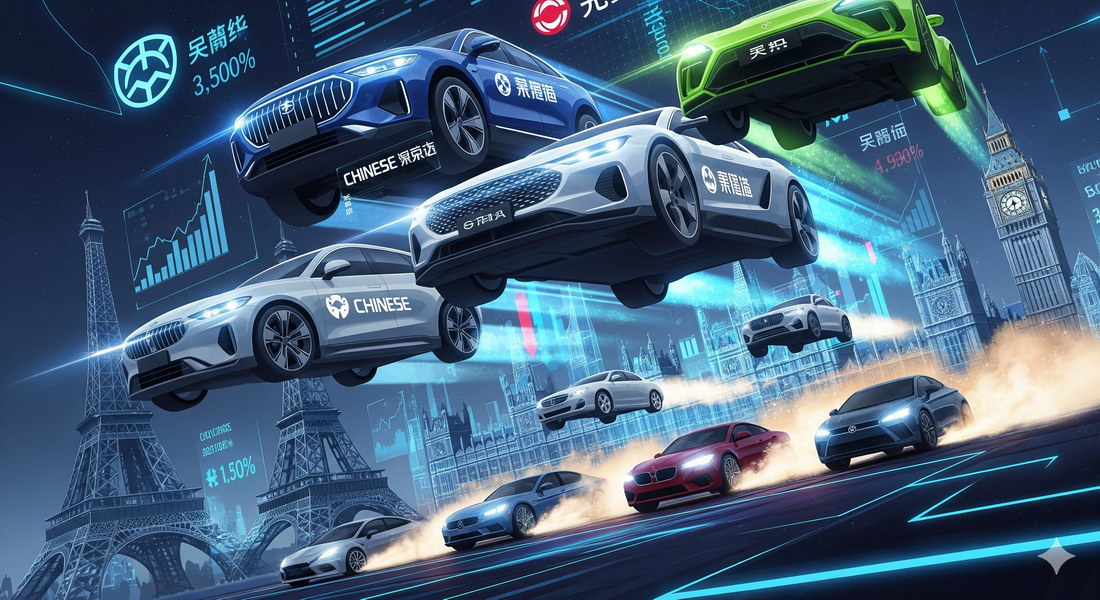
The European automotive industry is facing unprecedented disruption as Chinese automakers gain rapid market share. These brands combine innovation, affordability, and performance, forcing European manufacturers into a defensive position. The result is a seismic shift in the global automotive landscape that few predicted would arrive so quickly.
The Rise of Chinese Automotive Power
Chinese carmakers have moved far beyond the reputation of producing low-cost vehicles. They now deliver models that rival or surpass European cars in both quality and performance. With electric and hybrid options leading the charge, Chinese brands are capturing the attention of price-sensitive yet quality-conscious European consumers. The aggressive pricing strategy further highlights the vulnerabilities of established brands that depend on inflated premiums.
This rise illustrates how innovation paired with affordability reshapes consumer preferences. As a result, once-dominant European giants are witnessing their market share erode at a shocking pace. Chinese manufacturers now symbolize a future-oriented industry shift. Their cars are no longer considered alternatives but direct competitors to Europe’s luxury and mainstream segments.
China’s car industry is accelerating at record speed.
BYD AT3: Redefining Affordability
The BYD AT3 epitomizes how Chinese vehicles disrupt the European SUV market. Costing significantly less than premium German rivals, it integrates features that competitors sell at steep markups. Autonomous driving capabilities, fast charging, and impressive performance come standard, proving that advanced technology no longer has to come at a luxury price. Consumers are drawn to this value proposition in increasing numbers.
BMW and Mercedes executives openly worry about the implications of such models. Internal communications reveal their concerns over losing pricing power, as the AT3 eliminates the traditional justification for paying double. The performance advantage further reinforces BYD’s confidence in challenging European dominance. This single model represents a turning point in consumer trust toward Chinese engineering.
Xpeng P7: Technology Beyond Reach
The Xpeng P7 demonstrates a direct challenge to BMW in both software and engineering sophistication. Unlike European cars that charge thousands extra for incomplete autonomous systems, the P7 integrates advanced driver-assistance as standard. This shift forces consumers to question why they should pay premiums for less capable alternatives. Xpeng shows that technology should serve the driver, not inflate the invoice.
Furthermore, the P7’s build quality competes with luxury sedans while undercutting them by tens of thousands of euros. Performance metrics prove that marketing prestige does not guarantee better results. The P7 illustrates how China’s rise is not just about affordability but also about redefining automotive intelligence. As more Europeans test these models, brand loyalty weakens for traditional manufacturers.
Great Wall Aura 03: Breaking the Luxury Illusion
The Aura 03 provides luxury experiences that European brands traditionally reserve for customers willing to spend €60,000 or more. By offering such features at nearly half the price, Great Wall exposes the artificial scarcity and inflated pricing tactics of European companies. This reality dismantles the notion that luxury must come at excessive cost. Consumers see little reason to overspend when alternatives are equally refined.
High-quality interiors, superior comfort, and reliable performance shift the value equation entirely. Instead of exclusivity through cost, Aura 03 brings inclusivity through accessibility. This move forces European luxury automakers to rethink their strategies or risk irrelevance. The disruption challenges decades of brand dominance by targeting one of Europe’s most profitable segments.
BYD Seal: A Performance Game-Changer
The BYD Seal redefines the standards for sports sedans in Europe. Its acceleration, handling, and efficiency match or exceed vehicles costing twice as much. European brands have long restricted performance to maintain hierarchies among their models, but BYD breaks this pattern. By delivering maximum capability at a fair price, it appeals directly to drivers who value speed and reliability.
Leaked data from BMW highlights concerns about the Seal’s superior metrics. Consumers increasingly view it as an honest representation of what a performance sedan should offer. With extended warranties and lower service costs, the Seal challenges European dominance not only in performance but also in ownership experience. This model highlights the fading relevance of traditional premium positioning.
Nio ES8: The Existential Threat
The Nio ES8 demonstrates the overwhelming technological advantage of Chinese automakers. With autonomous driving features, battery swap technology, and spacious design, it easily outpaces German competitors like the Mercedes EQS. Its price point, however, is nearly half, further amplifying its threat. European manufacturers, recognizing their inability to match these innovations, have stopped direct comparisons in official communications.
For consumers, the ES8 represents a smarter, more affordable choice that refuses to compromise on quality. For European automakers, it signals a crisis of competitiveness that protectionist tariffs may not be able to solve. The ES8 epitomizes the future of mobility where innovation, service, and efficiency outweigh tradition. Its arrival symbolizes the shifting balance of automotive power in Europe.
Geely Zeekr 001: Premium Without the Price
The Geely-owned Zeekr 001 represents another blow to European luxury manufacturers. Positioned as a sleek, high-performance electric shooting brake, it rivals Porsche and Audi models that cost tens of thousands more. With extended range batteries, cutting-edge connectivity, and bold design, the Zeekr 001 offers a futuristic package at a disruptive price point. European brands struggle to justify their costs when Zeekr provides equal or superior value.
Zeekr’s success shows how Chinese manufacturers can blend premium aesthetics with technological superiority. By delivering an elegant yet affordable alternative, Geely proves that luxury and performance no longer require a European badge. This erodes the exclusivity narrative upon which German automakers have relied for decades. The Zeekr 001 firmly establishes China as a force in the premium EV space.
SAIC MG4: Affordable Innovation for the Mass Market
The MG4, produced by Chinese giant SAIC, has become one of the most popular budget EVs in Europe. Its success stems from offering solid range, advanced driver assistance, and modern styling at a fraction of the cost of European equivalents. Unlike German brands that position EVs as luxury items, the MG4 makes electrification accessible to mainstream buyers. This democratization of EV technology puts immense pressure on Europe’s entry-level and mid-range markets.
Consumers are increasingly drawn to MG’s combination of reliability, affordability, and practicality. With strong after-sales support and competitive warranties, the MG4 eliminates the barriers that once limited EV adoption. As a result, European manufacturers now face a growing challenge in their home market. SAIC’s MG brand exemplifies how Chinese automakers dominate not only the luxury but also the everyday car segment.
European Industry in Retreat
Rather than matching Chinese innovation with better vehicles, European manufacturers seek political protection. Their reliance on tariffs and quality propaganda highlights desperation instead of progress. This defensive stance exposes their vulnerability and signals an industry unable to evolve under pressure. Calls for government aid reveal how much ground has already been lost.
Meanwhile, Chinese companies expand production within Europe, offering higher wages and better working conditions. This further weakens loyalty to legacy brands. The contrast between growth and retreat paints a clear picture of where the future lies. For many, the shift toward Chinese brands appears not only inevitable but also desirable.
The European automotive industry is collapsing under the weight of competition it underestimated. Chinese brands like BYD, Xpeng, Great Wall, Geely, SAIC, and Nio are reshaping expectations with superior technology, lower prices, and reliable quality. As consumers embrace these alternatives, the once-unshakable dominance of European automakers fades. The transformation is not temporary—it signals a permanent change in the global automotive order.